
Rosacea, Redness & Flushing Treatment Melbourne
For skin that runs red.
Long-pulse Nd:YAG and Frac3 for rosacea, persistent facial redness and flushing. A management approach, paced gently, calibrated to your skin at a free consultation.
Redness that stays, and flushing that arrives uninvited.
Rosacea is a chronic condition: it isn't cured, it's managed, and managed well it changes how skin looks and feels day to day. The visible redness, the flushing episodes, the fine vessels that build over time, all of it responds to vascular laser work.
Not all facial redness is rosacea, though. Some faces carry redness from years of sun, some flush with heat or stress or hormones, and some hold the pink marks acne leaves behind. This page covers all of them, because they share one thing: vessels sitting too close to the surface, doing too much. Facial redness treatment at Pink begins with those vessels, wherever the redness came from.
Five faces of redness.
Diagnosed rosacea
You know what it is. You're managing triggers, perhaps using prescription care, and you want the visible redness reduced.
Redness without a name
Persistent pink or red cheeks that never quite settle. Nobody's called it rosacea. It bothers you anyway.
Sun-built redness
Years of Australian sun have left a permanent flush across the cheeks, nose or neck.
Menopausal flushing
Flushing that arrived with perimenopause and left a redness that lingers between episodes.
After acne
The breakouts settled, but pink and red marks stayed behind where they were. Post-inflammatory erythema, if you've met the term.

Two ways the laser quiets redness.
Vascular work, vessel by vessel.
The Fotona long-pulse Nd:YAG at 1064 nm reaches the dilated vessels that hold redness in the skin. The energy is absorbed by the blood, the vessel closes, and your body clears it over the following weeks. It's the same precise vascular capability behind our Laser Vein Removal, applied here across the diffuse redness of rosacea-prone skin.
Because the wavelength targets blood rather than pigment, it suits a broad range of skin tones, assessed clinically at your consultation.
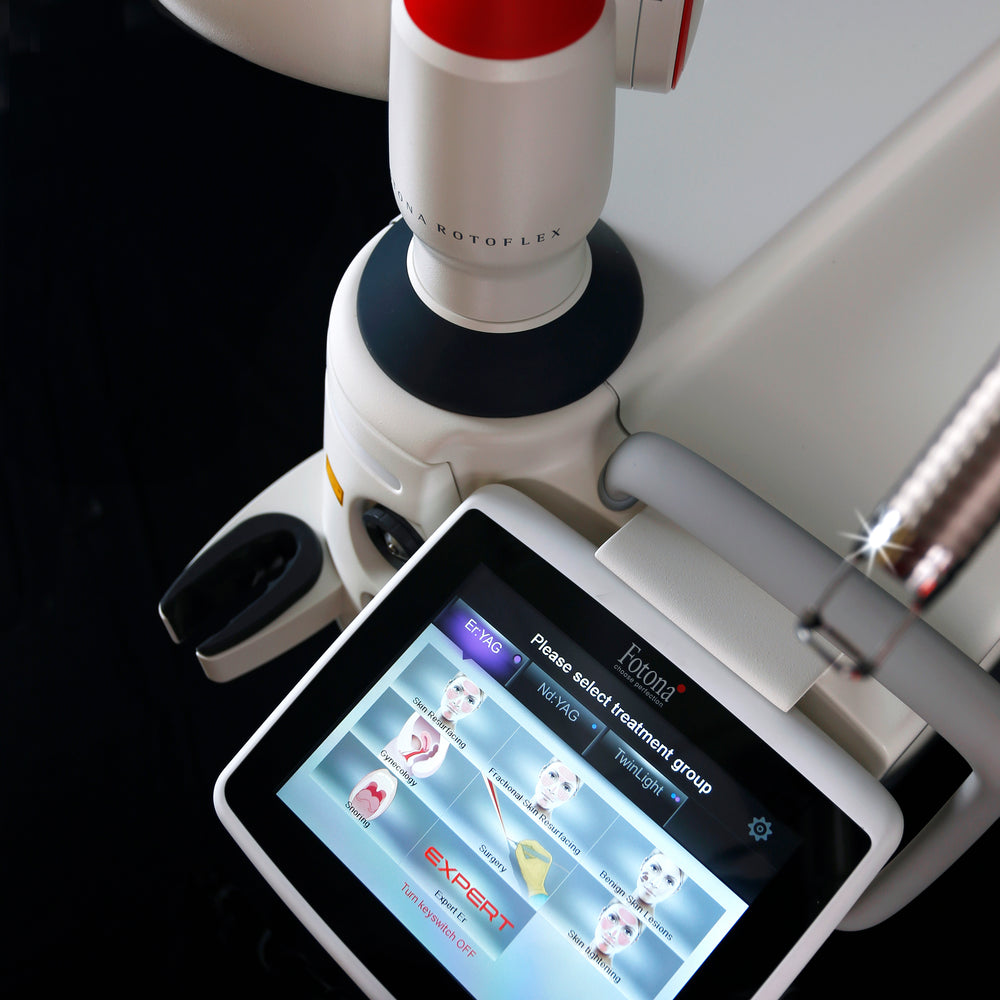
Frac3, for the redness between vessels.
Frac3 is a fractional mode of the same Nd:YAG laser. Rather than tracing individual vessels, it works across the skin in a fine three-dimensional pattern, settling the diffuse background redness and supporting the skin's texture as it calms. Our Redness & Flushing treatment is built on Frac3 alone, and it also closes a fuller Rosacea session.
Which approach fits, and in what measure, is your clinician's call at consultation, for the skin in front of them.
In one published study of the 1064 nm Nd:YAG laser technology Pink uses, roughly four sessions brought good-to-excellent improvement for around 8 in 10 people with the common redness-and-flushing form of rosacea. Across the wider literature, long-pulse Nd:YAG matches the most-studied alternatives on results, with less discomfort and no bruising.
Results vary between individuals; your consultation sets the course for your skin.
LED, between laser sessions.
Yellow and near-infrared LED light is the gentle companion to vascular laser work: no heat, no downtime, just a calming, anti-inflammatory session that supports your skin between treatments and helps maintain the result after a course. It's part of our LED Light Therapy room, where redness has its own protocol.
Rosacea, redness, or flushing?
A chronic condition: persistent central-face redness, flushing episodes, sometimes bumps and visible vessels.
Vascular laser for the redness and vessels, with LED between sessions to keep the skin calm.
Diffuse pink or red that stays put, from sun, skin history or simply your skin's nature. Not always rosacea.
The same vascular and Frac3 work, scoped to the areas that carry the redness.
Sudden waves of heat and colour, triggered by warmth, stress, food, or hormones, that build lasting redness over time.
Laser settles the vessels that flushing has built. The triggers themselves are managed alongside, not lasered away.
Flushing with menopause, or rosacea?
They overlap, and they're often confused. Menopausal flushing tends to arrive in short waves with warmth and sweating, head to chest. Rosacea flushing sits in the central face and leaves more colour behind each time. Many women in their forties and fifties live with both at once.
Laser treats the lasting redness and the vessels that repeated flushing builds in the skin, whatever set them off. Many women pair it with hormonal care through their GP, and the two work well together.
Gently, over a few months.
Redness work is gradual by design. Six sessions is the recommendation, one to three is a good place to start, and your clinician spaces them a few weeks apart on how your skin responds. Clients come to us for exactly this work from Box Hill, Balwyn, Templestowe and across Doncaster.
Consultation
Free, and unhurried. Your clinician assesses your redness, tells you what laser can do for it, and recommends where to begin.
Treatment sessions
You'll feel warmth and quick pulses, with cooling throughout. Expect some mild redness for a day or two afterwards, then your skin settles calmer than it started.
Maintenance
Rosacea is a condition you manage, not one you finish. Most clients return once or twice a year to keep the result, with LED and home care holding the calm in between.
Suited to most skin, timed well.
Laser redness work suits most skin, with a few timing exceptions: pregnancy, active skin infection, and recent courses of certain acne medications. Your consultation covers all of this, and prescription care, where you use it, sits comfortably alongside a laser course.
And if what you're seeing is individual thread veins or spider veins rather than diffuse redness, that's its own treatment: Laser Vein Removal. Or see both treatments side by side: Vein, Rosacea & Redness Treatments.
Supporting your skin at home.
Redness-prone skin asks for gentleness: a soft cleanser, daily mineral SPF, and knowing your own triggers, heat, sun, certain foods, and giving them less room. Our clinicians will walk you through it without overwhelming your bathroom shelf.
Between laser courses, the Rosacea variant of our Signature Facial keeps reactive skin calm, and our Pink Skin Care range carries the gentle, barrier-first options.
Priced by area, built as a course.
Choose your treatment, the area that carries your redness, then how many sessions to begin with.
✦ The Plus One on now · 15% off 3 sessions · 20% off 6 sessions

“I trust them and never question their assessment. This is a place and a team that would genuinely give you the right advice that works for you and one that you need.”
The clinician behind the calm.
Redness work rewards a clinician who works across the whole toolkit. Stephy, our Multi-Modality Laser Specialist, leads consultation and course design for rosacea and redness at Pink: she sets the pathway, balances vascular work with Frac3, and paces the course to how your skin actually responds.
Porsha, our Founding Senior Dermal Clinician, designed Pink's protocols with the clinical team and directs how they evolve, so every redness course at Pink runs to the same standard.
The cooler face.

A documented rosacea and redness case from the laser room. Diffuse facial flushing calmed over twelve months, on barely three vascular sessions and a deliberately minimal routine. The redness lifted in the VISIA scans, and the heat of a hot day eased with it. Managed, not cured, and recorded in full.
Read the case file →Rosacea, explained.
The longer reads, for when you want to understand it before you book.

The evidence
Does laser work for rosacea?
What the published studies actually show for reducing rosacea redness, and where the limits are.
Read article →
The triggers
Triggers and flare-ups
Heat, wine, stress and sun: how to find your pattern, and how to calm a flare when it rises.
Read article →
The honest answer
Can rosacea be cured?
The straight answer, why managed beats cured, and what laser can realistically do.
Read article →Frequently Asked Questions
Can rosacea be cured? +
Do I need a diagnosis or GP referral before treatment? +
Does laser work for redness that isn't rosacea? +
Can laser help with menopausal flushing? +
What is Frac3? +
How many sessions will I need? +
Does it hurt? +
Is it safe for Asian, olive or darker skin? +
What happens after a session? +
How should I prepare? +
What's the difference between rosacea and broken capillaries? +
Should I choose Rosacea or Redness & Flushing? +
Can I have a facial instead? +
Is laser for redness covered by Medicare? +

Let's look at your redness, together.
Start with a free consultation. Your clinician assesses your skin, tells you honestly what laser can do for it, and recommends where to begin. We're on Doncaster Road, a short drive from Templestowe, Box Hill, Balwyn and Manningham.
Book a free consultation Or call the clinic on 1300 549 008Doncaster
Where to find us.
Doncaster. Shop 3, 642 Doncaster Road.
Address
Pink Laser Clinics, Doncaster
Shop 3, 642 Doncaster Road
Doncaster VIC 3108
Contact
clientcare@pinklaserclinics.com.au
Clinic Hours
- Monday
- 11am – 6pm
- Tuesday
- 10am – 7pm
- Wednesday
- 10am – 7pm
- Thursday
- 10am – 8pm
- Friday
- 10am – 7pm
- Saturday
- 10am – 3pm
- Sunday
- Closed
Reviews
4.9 from 448+ Google & Yotpo reviews